Electoral Synchronisation Risk (ESR) is a system-level framework for analysing how overlapping election cycles and leadership transitions across allied democracies can temporarily increase coalition strategic decision latency in fast-moving security crises. The claim isn't that democracies "fail" or militaries go offline: it's that authorisation and alignment slow down when multiple political calendars collide.
Most security analysis is obsessed with hardware: ships, missiles, basing, inventory, production rates. ESR is about something subtler (and more annoying): the political time constant of a coalition. When crises move faster than the coalition's ability to authorise escalation-capable responses, timing itself becomes a risk mechanism.
/1What ESR actually is (and what it isn't)
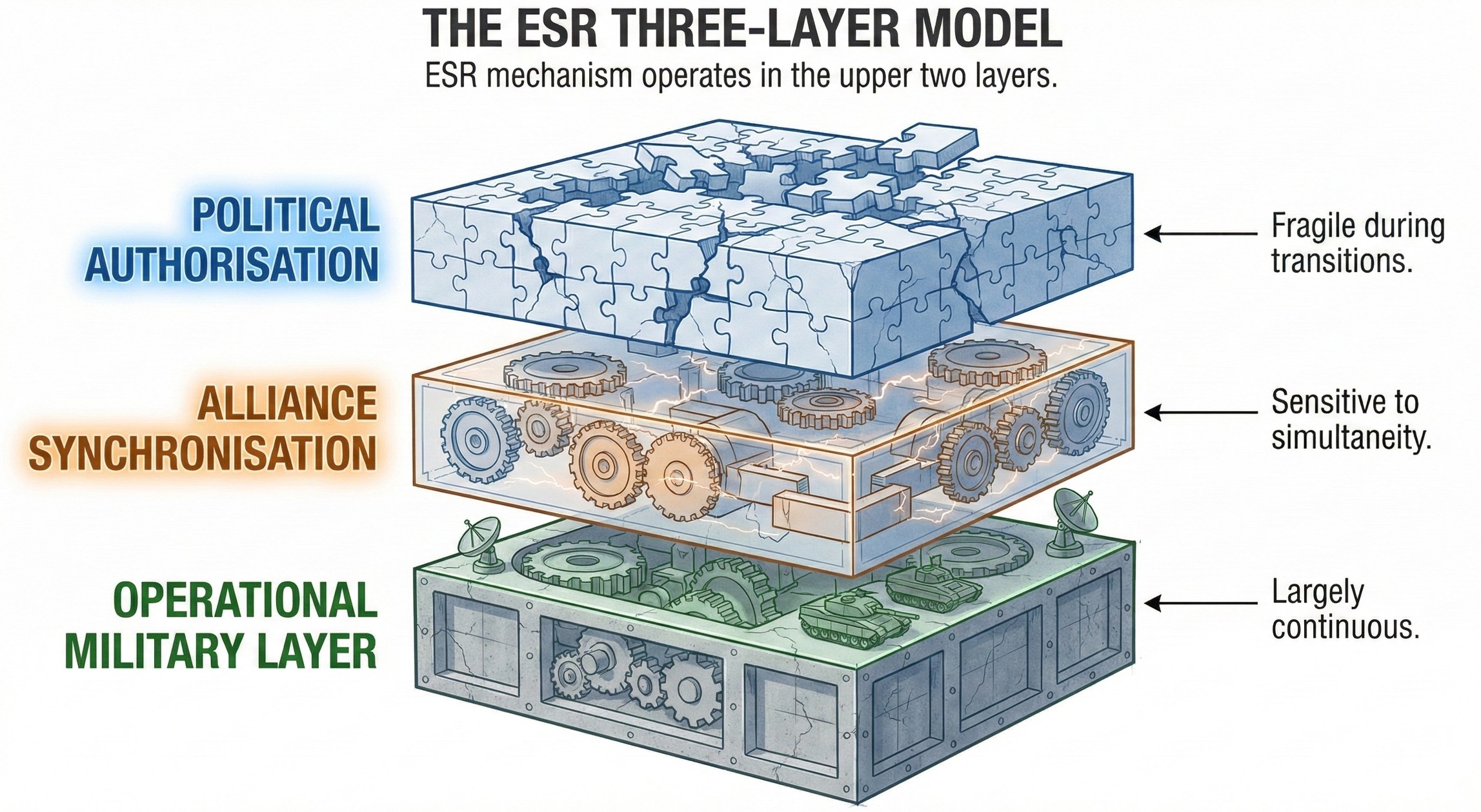
/2The key distinction: continuity vs permission
The most common objection is the "institutional continuity" argument: militaries and intelligence communities operate regardless of elections. True. And incomplete.
Two layers, two clocks
Kinetic Readiness (largely constant): standing defence plans, intelligence collection, tactical self-defence, pre-authorised ROE.
Escalatory Permission (variable): horizontal escalation, reserve mobilisation, multi-lateral sanctions, alliance-binding commitments, all requiring fresh political authorisation.
Elections don't remove legal authority to act, but they compress the political tolerance for decisions that move beyond the status quo. In ESR terms: the "hardware" is on, but the "permissioning" layer gets sluggish.
/3A practical proxy: Coalition Strategic Decision Latency (CSDL)
To ground the concept, the paper introduces Coalition Strategic Decision Latency (CSDL): the elapsed time required for a multi-state coalition to grant escalation-capable permission beyond standing authorities.
/4The asymmetry problem: fragmentation vs consolidation
ESR is structurally asymmetric. Democratic coalitions have visible, frequent leadership transitions; counterparts may have longer periods of leadership continuity or centralised consolidation. That can create a temporary divergence:
- Democratic fragmentation: mandate-seeking, cabinet-forming, domestically constrained signalling.
- Authoritarian consolidation: lower internal friction and potentially faster escalatory authorisation.
This isn't a moral claim and it's not a prediction of behaviour. It's a timing divergence: the decision delta between systems can widen at specific moments.
/5Why this is portable beyond the Indo-Pacific
The Indo-Pacific is used as an illustrative application, but ESR is not region-specific. It applies wherever:
- credible response requires coalition action;
- escalation-capable decisions require political authorisation;
- multiple coalition members are in simultaneous transition windows.
Plain English takeaway
Early action is easiest when others are still deciding, and hardest once they've aligned.
/6How to use ESR without becoming a doom merchant
ESR is useful as a calendar-aware stress test for coalition decision systems. It suggests very specific, non-hysterical questions:
- Which actions are covered by standing authorities vs requiring new political permission?
- What pre-authorisations (or delegated authorities) reduce the "permission gap" in high-ESR windows?
- Where are the coalition's slowest veto points, and can they be pre-solved?
- How does signalling coherence change during campaign periods?
/7Closing
ESR doesn't claim coalitions are weak. It claims that timing can become a mechanism, and it's measurable enough to take seriously, model, and mitigate before hindsight shows you the pattern in high definition.